We cycled more than 7,000 kilometres from B.C. to Halifax to see Henry.
People said we were crazy. People said we were brave. People shook their heads at what we wanted to do. But we made it.
WE MADE IT!!!
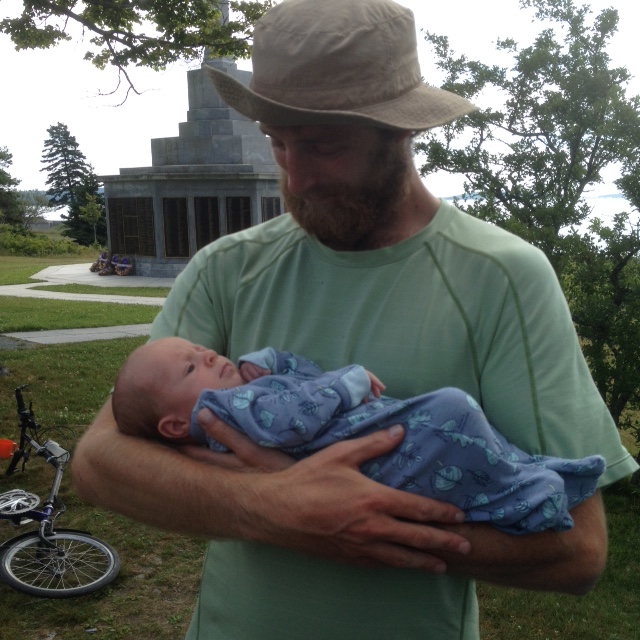
Granddad holds Henry, his first grandchild, for the first time.
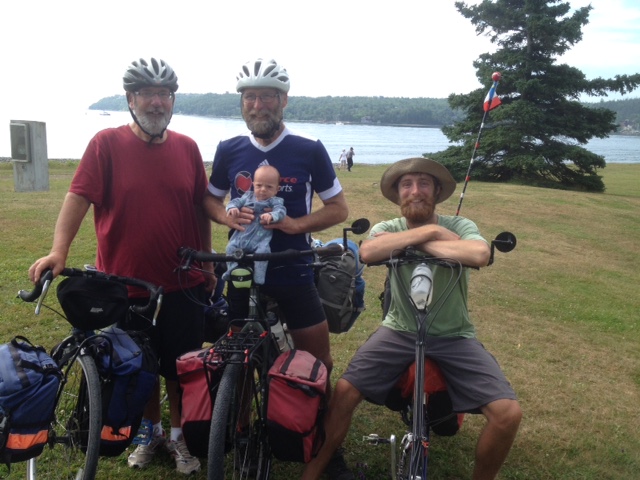
Clive, Brody and I completed our journey from British Columbia to Halifax on Sunday with a big reward, especially for Clive. New proud papa Bryce, who had joined us the night before at our final campground in Laurie Provincial Park, escorted us to Point Pleasant Park where Clive’s first grandchild, five-week-old Henry, was being held by his mother Breanna.
Uncle Brody!
Clive beamed, and so did new uncle Brody, as they took turns holding the little guy.
It was a special moment for them.
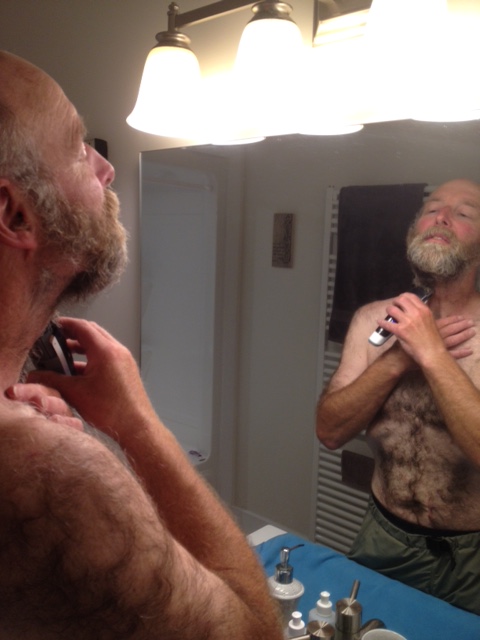
Clive takes a razor to his trip beard, and shockingly, his decades-old ’stache.
Then it was off to Bryce and Breanna’s home for another reveal. That’s where Clive took a razor to his 12-week-old beard and decades-old moustache, and also showed off his new physique after shedding 50 pounds in the process of this trip.
Granddad shows his new look off to Henry.
It’s been quite the epic journey for us. Ecstatic we made it, happy to get back to our lives, but kind of sad because we’re going to miss the riding and seeing new places.
I’m extremely grateful to Clive for dreaming up this trip and allowing me to join in. Considering how mechanically and campground challenged I am, I couldn’t have done it without him.
He certainly could have done it without me and might have preferred that, but I’m happy he let me come on a trip of a lifetime.
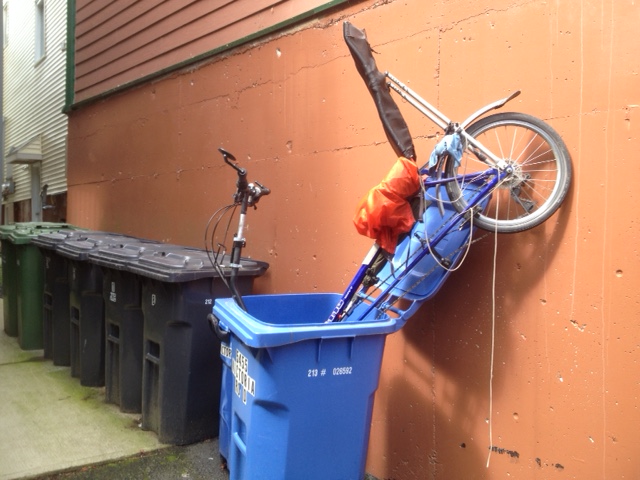
Brody broke the back of his recumbent on the penultimate day of the trip. He and his dad did some MacGyver work on it with rope and old inner tubes to hold it together for the final day. When we arrived at Bryce’s place he threw it in the recycle bin, although he later reclaimed it and plans to give it away.
Cross Canada by the numbers
7,165 – Kilometres ridden by Grant from Burnaby, B.C., to Halifax, N.S., excluding many trips around towns stayed in, most commonly going doubling back and forth to towns for grub. If those were included total would easily exceed 7,500 kilometres.
350.5 – Hours in the saddle to ride those 7,165 kilometres
20.42 – Average speed over those 350.5 hours
65.33 – Maximum speed achieved on a hill in Quebec. Second highest was more than 62 km/h on a hill the first day in the Fraser Valley.
170 – Kilometres on longest daily ride from Clear Lake Campground in Iron Bridge, Ont., to Centennial Park Campground, Greater Sudbury, Ont.
8 – Total flats for all of us
4 – Clive’s flats
3 – Grant’s flats
1 – Brody’s flats
86 – Total days on trip
74 – Riding days
12 – Rest days
57 – Nights spent in campgrounds by Grant during trip to Halifax
29 – Nights spent in private campgrounds
14 – Nights spent in municipal campgrounds
8 – Nights spent in provincial park campgrounds
6 – Nights spent in national park campgrounds
17 – Nights spent in motel rooms
11 – Nights spent staying with relatives
50 – Pounds lost by Clive from start of his training for trip to end
1 – Clive’s grandchildren born during trip
Kilometre count
Day 83: Shubenacadie, N.S., to Laurie Provincial Park, Grand Lake, N.S., 37 km; Total: 7,030
Day 84: Side trips from Laurie Provincial Park, 47 km; Total: 7,077 km
Day 85: Side trips from Laurie Provincial Park, 50 km; Total: 7,127 km
Day 86: Laurie Provincial Park to Bryce/Breanna/Henry’s home, Halifax, 38 km; Total: 7,165 km
From a concealed position in the woods I look out over the parking lot behind the hotel. Nobody’s around. Earlier in the day a man had been doing maintenance work on the swing set and I had to call off my morning attempt. I do a quick scan of the patios that back the hotel rooms and see that these too are empty. Perfect. I doubt the boozy layabouts of these patios would bother setting down their cocktails to report me to the hotel staff, but it’s better not to chance it.
Wearing only swim shorts and flip flops, a towel draped over my shoulder, I saunter across the parking lot. I find it best to look and act as though I belong, as though I’m a guest of the hotel, although most guests access the pool through the hallway rather than by using a stack of chairs to climb onto the sun deck. Having a nimble climbing physique is helpful to make this somewhat conspicuous part of the process go quickly and smoothly. Less than five minutes after leaving my dirtbag locale on the far side of the woods, I’m getting my sweat on in this small resort town just east of the prairies.
During the last year of my degree, I took a self-directed course in applied sweatology in the sauna and steam room of the UBC Aquatic Centre. I knew going from a twice-a-week sauna habit to a life on the road was going to pose some challenges. But challenges are good for us, they push us out of our comfort zone and help us grow. For instance, I have a great admiration for my uncle having to spend most nights this summer sleeping on the ground after not having camped since his childhood (he tells me that he wasn’t a big fan of it then, either). He has undoubtedly gained a deeper appreciation for his queen-sized bed than he had before transcontinental tenting. For myself, I do not take sauna access for granted now as I did before the trip.
There were entire provinces through which sauna going was out of the question (P.E.I. had no public saunas, and Quebec would have pushed me perhaps just a bit too far out of my comfort zone). But there has been a rich assortment of sweat opportunities across the nation, and my seeking of saunas no doubt made me more familiar with the people and places that I visited. At the time of writing this, at Laurie Provincial Park about 30 kilometres north of our final destination of Halifax, I’ve been to a total of 15 saunas and steam rooms since setting out in May. A full list of these is at the end of the blog.
Perhaps you’re Finnish, and I no more need to explain my love of saunas to you than I would need to explain what beer is for. Perhaps you’re like many people in our culture who don’t give much thought to saunas, who have a been in the odd sauna on occasion and have found them to be little more than an uncomfortably hot room with hard seating. Maybe after reading this you’ll head to your local aquatic centre and have yourself a little sweat. Maybe you’re lucky enough to have your own sauna. Maybe you’re reading this in your sauna. So be it (though I’m personally against the use of electronic devices in saunas.) My purpose is to convey my affection for a sauna session, whether or not your opinion of saunas is swayed is of little importance.
In cold climates, saunas improve blood circulation to my extremities. In hot climates, they improve my ability to deal with the heat. They help to relax the muscle tension that I get from consecutive days of cycling for many hours. If I have a cold, a few trips to the sauna are sure to speed my recovery and clear my congested sinuses. If I’m stressed, the atmosphere of the sauna calms me. I’ve read they help the body excrete unwanted things, but I’m unqualified to say whether or not this is true. If it is true, and my pores are pushing out heavy metals, that’s great. If it’s just Big Sauna pushing its corporate agenda through new-age propaganda, I’ll still go sit in the sauna. I’ll sauna alone, I’ll sauna socially, I’ll sauna day and night, because I love to sauna.
Before getting into the sauna list, I’d like to thank my family in St. Albert for setting me up with a YMCA membership. The YMCA facilities I’ve visited have been some of the best of the trip, partly because the male and female change rooms each have their own sauna so one may sauna in the nude, which has always been my preference. I’m greatly looking forward to many visits to the YMCA during our stay in Halifax next week.
Now for my personal favourites. The award for best view goes to the sauna at the Log Inn Pub in Avola, B.C., from which you can look down the Thompson River Valley and watch the trains as they go by. The award for most unique goes to the infrared sauna at the home of the massage therapist who I received treatment from in Edmonton, which was a half-tube just big enough to lay under as it gently cooked my body (with my head sticking out of the end of the tube). Best overall facility goes to the YMCA in St. Albert, which has a towel service and a very nice steam room in a gender-specific space. And, drum roll please, the best sauna goes to the YMCA in Ottawa, also gender specific, nice and hot, allows water on the stove, and for which I didn’t pay a dime thanks to my Northern Alberta YMCA membership.
Brod on the road saunas Summer 2016:
Merritt, B.C. – Public pool sauna
Kamloops, B.C. – Public pool sauna
Avola, B.C. – Log Inn Pub sauna *Awarded Best View*
Jasper, Alta. – Public pool steam room
Hinton, Alta. – Public pool steam room
Edson, Alta. – Public pool sauna
St. Albert, Alta. – YMCA steam room *Awarded Best Overall Facility*
Some of the spectacular views along the Confederation Trail in Prince Edward Island.
Prince Edward Island gave us confederation when the original plan for our country was conceived in 1864, and now it’s setting the standard for blazing a trail in cycling infrastructure with the Confederation Trail.
It’s more than 400 kilometres of path that runs the length of P.E.I., with several branches to different parts of the island. It’s a joy to ride, for the most part, and other provinces would do well to imitate it.
Typically me, a bicycle and gravel don’t make a threesome. But this is an exception, although I’m not sure what I’ve done on the trail’s gravel surface the last few days on the Kona Sutra I’d have attempted on my precious carbon-fibre bike.
Clive contentedly pedals the Confederation Trail.
When we crossed the Confederation Bridge by shuttle last Thursday, one of the trail’s branches began right behind our campground. There was no need for its builders to carve paths out of the woods because they used abandoned railway rights of way. The beauty of that is railways can’t have more than a two per cent grade, so there’s no steep hills to climb. That’s not the case in the rest of Prince Edward Island where the highways all have no shoulders and lots of little hills to climb.
The Trail is wide and, most importantly, free of motorized vehicular traffic. You’re out there on your own, the only sound being the churning away of the pedals while you enjoy the beautiful scenery as it winds through farm fields and tiny towns. And it’s well cared for by a large corps of volunteers who mow the grass that grows in the middle of the trail and on both sides of the well-treed trail.
Clive at one of the many picnic shelters on the Confederation Trail.
A big feature is every few kilometres there’s a clean, stable picnic table – usually sheltered – for bikers to rest or lunch at. There’s even the occasional washroom en route.
If there’s one complaint, it’s they’ve tried to make it too aesthetically pleasing by putting down pea gravel and levelling the path out. That slows down bicycles forcing riders to plow their way through it. I got to the point where I was thrilled to see the grass growing down the middle because that meant riding on the basic old railway path with its hard-packed surface.
The low-grade inclines, though, meant it’s possible to maintain consistent speeds.
It’s actually part of the Trans-Canada Trail and P.E.I. is the first province to complete its contribution. Granted, the province is puny compared to all the others, but they could take a lesson from the Islanders and build similar infrastructure. Quebec is off the hook in that regard, though. It has oodles of cycling infrastructure with its La Route Verte with a network of roads and paths spanning more than 5,000 kilometres and has lots of quiet highways with good shoulders. But Prince Edward Island, despite the birth of the Confederation Trail, isn’t off the hook for its network of highways with no shoulders.
Nobody descended from the skies at PEI National Park’s Stanhope Campground, but it sure seemed like someone would for a few minutes.
• After spending Friday and Saturday nights at Prince Edward Island National Park’s Stanhope Campground, Clive wanted to go to a church at least once this trip. From a trip in 2010 with Cheryl, he knew there was an Anglican church in downtown Charlottetown. We assumed the service was at 10 a.m., but we also knew it was close to 40 kilometres away.
Even though we got up early, we didn’t take off until a few minutes after 8 o’clock. Time was tight. Most of the trip was over the Confederation Trail, but we pedalled hard through the gravel and up the inclines. (We weren’t singing Get Me To The Church On Time from My Fair Lady, but it did cross our minds.) It was a good cardio workout and we made it, a little bit smelly in our armpits, with about 10 minutes to spare.
Clive was asked by the pastor to talk about the trip to the congregation, and then afterward he, Brody and I – even though of the two of us didn’t attend the service – were invited by two church members to lunch at their lovely waterfront home in downtown Charlottetown. Many thanks to Bea and John for the lovely lunch. (The date cake was to die for!)
Stanhope campers flocked to the beach every evening to see the sunset.
• While Clive and Brody took a break Saturday, I decided to do a round trip ride to Cavendish. It’s where the national park has its Anne of Green Gables site. I saw it during a band trip in 1973, so wasn’t interested in a return visit. Not my cup of tea, so to speak. I opted instead for a lobster roll at Razzy’s Beachhouse before heading back to Stanhope.
• Kudos to Clive for being the only one of to reach the top of Vista Bay campground hill just east of Charlottetown without getting off his bike.
We camped there for two bug-infested nights. To get there involved a climb up a long, steep – we’re guessing about 12-15 per cent grade – slope on a track of rock, gravel and P.E.I. red clay. There was no question the first night we would have to walk at least a portion because our bikes were laden with heavy panniers. I made it about two-thirds of the way up before succumbing.
With only one saddle bag on the second night, I thought I was going to make it, but I got about 80 per cent of the way before hitting a soft patch where I couldn’t generate any traction and had to walk the bike for about 30 metres.
Later, I went back to witness Clive’s attempt. He hit the same soft spot but made it through and then made it all the way to the top. If you’d seen the treacherous track you’d realize what an accomplishment it was.
Conversely, the first ride down was scary. I passed few bricks through my bowels as we dodged the obstacles. So when we left the next morning with our bikes bogged down by weight we opted to walk all the way down.
• Being in the Maritimes, and particularly P.E.I., I wanted to sample the local flavour, especially the seafood. Maybe I didn’t go to the right places because for the most part they were average. The one exception was the Gahan Brewery Pub in Charlottetown where I had a delicious seafood jambalaya and chowder.
The fries, on the other hand, were almost universally good at every spot. I don’t normally order that many fries, but this was P.E.I., and it’s supposed to grow the best potatoes in Canada. They might be right.
• Keeping in the culinary vein, there’s a little island ice cream franchise called Cows that claims it’s been named the best in the world. I don’t usually buy into such hype, but, again, they might be right. I indulged twice with two flavours each time. The best just might have been one called PEI Apple Crisp. Yum! I almost succumb a third time since they had a Cows outlet on the ferry between P.E.I. and Nova Scotia. Fortunately the lines were too long and I wasn’t willing to stand around that long. But if I did I’m sure it would have been worth it.
We’ve arrived in Nova Scotia, our ninth and final province!
Kilometre count
Day 80: Sightseeing and shopping in Charlottetown. Did not record mileage
Day 81: Charlottetown/Vista Bay Campground to Caribou, N.S., 65 km; Total: 6,878
Day 82: Caribou, N.S., to Shubenacadie, N.S., 116 km; Total: 6,993
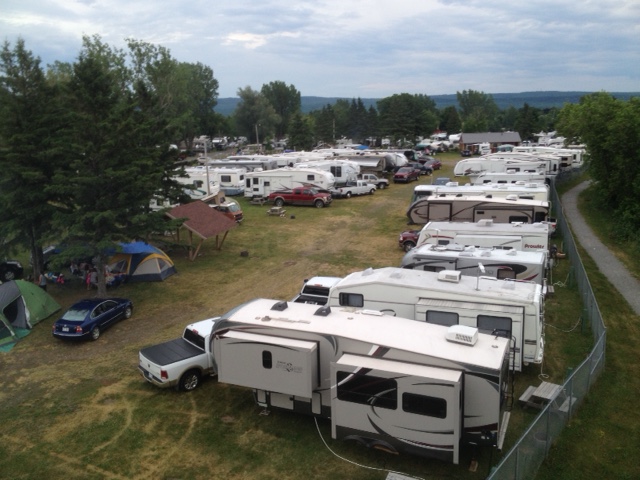
Some private campgrounds across the country are bursting at the seams with a cornucopia of recreational vehicles of all types at this time of the year.
Tom Selleck did his job very well.
Too well.
Sure he was hunky and handsome on television as Magnum, P.I. but his best TV work just may have been his voiceovers for the television commercials on both sides of the border that romanticized recreational vehicle travel.
They have worked.
We have witnessed the evidence on our epic cross-country journey.
Funnily enough, not necessarily on the highway.
And, funnily enough, not in idyllic isolated locations under moonlit skies sans mosquitoes.
Recreational vehicle s are lined up as far as the eye can see at a campground in Montmagny, Que., resembling an outdoor RV show.
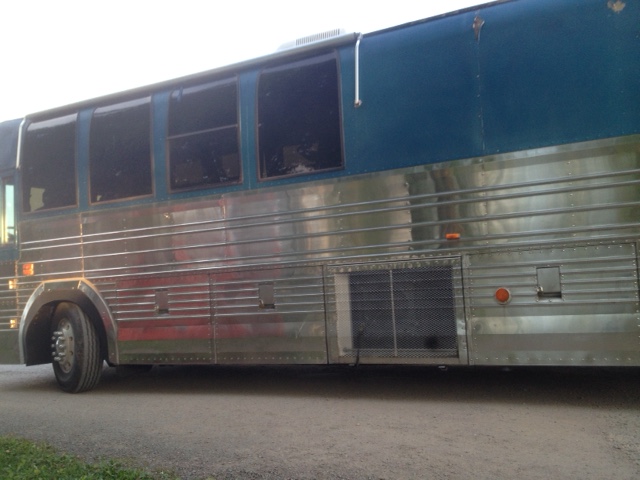
Campgrounds across the country – be they private, provincial or municipal – resemble, in Clive’s words, “RV shows” both in quantity and the bells and whistles on display. The campgrounds are crammed with massive RVs, giant trailers and truck campers of all shapes and sizes lined up one after another. They range from the $500,000 monsters and converted buses to a simple fifth-wheel trailer.
A converted bus pulled into the Parasol Camping grounds in Shediac, N.B. while we were there.
Tents?
Are you kidding? Except for the national parks (more on that later) they’ve almost become a camping pariah, left for the mountain climbing, cross-country skiing and kayaking crowd to keep alive in the back country.
Tents are often stuck in a corner at private campgrounds. The little yellow one is Grant’s, the one beside the bike is Clive’s while the one by the fence is Brody’s. The best part about this location was we were able to keep our bikes and bags beneath the covered shelter during a wicked wind and rainstorm that night.
There’s very few tenters, and private campgrounds often tuck them away from the labyrinth of 30-volt, 50-volt, drive-through sites catering to the RV crowd that make up the overwhelming bulk of business.
Most RVers prefer private parks. Most rent their spots over the long term, not by the night, and only occasionally by the week. They set down roots and stick around for the season.
That’s why as elaborate as the condos-on-wheels are, so are the sites. Many have permanent structures attached to the so-called vehicles. They have expansive patios, snazzy outdoor furniture, garden sheds, gardens, lawn decorations, and all sorts of outdoor paraphernalia you’d normally see in a suburban yard.
They are summer cottages more than they are vehicles to hit the highway all season long. The advantage is they’re snowbird cottages, too.
It seems many owners are of the retired variety. No surprise there. It also seems many have sold their homes and used the bucks to finance their extravagant travelling homes. So it’s summers in Canada and winter the U.S. Sunbelt.
It’s easy to understand that reasoning. It’s also easy to understand the desire for all the creature comforts of home away from home – stove, fridge, beds, bathrooms, kitchen tables, satellite television, etc. A thunderstorm hits, they can go inside. It gets too cold, go inside. If mosquitoes are on the rampage, and they frequently are, they can take cover inside (the RV owners that is, not the skeeters).
If they want to get away from the park for a bit or get groceries they don’t hop in the front of their recreational vehicle and fire it up. Nope. They get in the SUV they’ve towed behind it. (Some do get inventive in this regard. Clive and I spotted a long-distance truck in Northern Ontario not only towing his own recreational trailer but perched on the frame behind the cab there was a Smart Car.)
Many people shy away from owning a condo because they don’t like being having just a wall between them and their neighbours.
Well, in a campground there’s even less privacy.
Most don’t seem to have much more than only an arm’s length separation between each site. It’s hard not to notice the comings and goings of every camper, and it’s not hard to figure out what everyone on the block is having for dinner.
About 20 campers gather around the fire to socialize and keep the bugs at bay.
The closeness does breed friendliness, though. The residents – and make no mistake about it, they are residents and not vacationers – visit back and forth gathering around blazing fires. They wander the campground with beer cans or glasses of wine in hand.
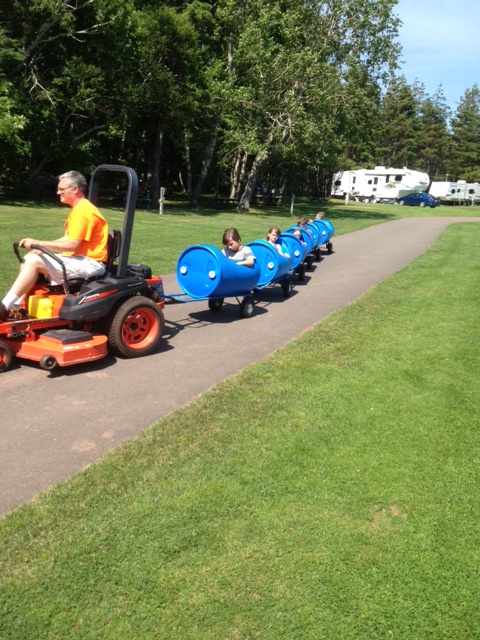
The operator of Jellystone Campground in Borden, P.E.I. gives some of the kids a ride in his makeshift train made from old rain barrels.
Some of the campgrounds put on special events for their customers. The other day in Shediac, N.B., Parasol Camping had a sign advertising its Christmas in July dinner for an upcoming Saturday night. Others cater to families, like Jellystone Campground (yeah, they even have a Yogi Bear statue and signs featuring Boo Boo and The Ranger) in Borden, P.E.I. at the foot of the Confederation Bridge.
Maybe Tom Selleck will show up as Santa Claus.
We stayed at several municipal campsites that are similar to the private ones, although they generally don’t have as much of a sardine-can feel to them as the private ones.
(The one exception to the RV shows disguised as campgrounds was the latest one we stayed at in Prince Edward Island. The info we had on Vista Bay Campground was it was attached to a golf course about nine kilometres outside of Charlottetown. When we got there all we could see was a fading sign at the end of a long, red clay road. There were no RVs, trailers or tents in sight. But it was late and our options were few so we ventured up the road to a farmhouse with equipment and stuff scattered all over the place. Yes, there was a campground, said the woman. It was up over the crest of the steep hill behind the farm. Sure enough, after pushing our bikes loaded to the handlebars up the hill we discovered there were RVs and trailers at the top in a small campground that was far from full. But the vehicles were blasts from the past, Winnebagos and trailers from the 1970s and ’80s. Owning the fanciest machine in the park was not a priority there.)
The national parks, however, are a different campground cat. Sure they have a fair share of the big boys rolling in, but most of the campers have tents.
Sure some of the canvas structures appear to be capable of housing a bouncy castle and are bigger than some condos on sale in Vancouver, but they are tents. There are lots of little toys for this set, too, but generally it’s a little more laid back. WiFi either doesn’t exist or you need to get up close and personal with the router at the office or the restroom areas just to get a weak online link that gets extremely frustrating. So most of those campers are prepared to be at least a tiny bit off the grid when they arrive.
At Prince Edward Island National Park’s Stanhope Campground, campers flocked to the beach every evening just to see the sunset. You now the kind. Just like the ones in the Tom Selleck commercials.
Kilometre count
Day 77: Borden, P.E.I. to Prince Edward Island National Park Stanhope Campground, 91 km; Total: 6,689 km
Day 78: Round trip from Stanhope Campground to Cavendish, 71 km.; Total: 6,760
Day 79: Stanhope Campground to Charlottetown/Vista Bay 53 km; Total: 6,813
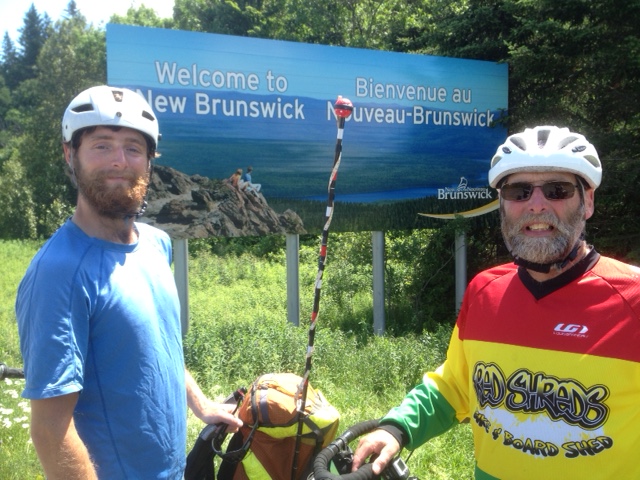
We’ve just made it to Prince Edward Island after about eight days in New Brunswick where we saw plenty of nice scenery and met some nice people, families and a canine puppy the size of bear cub.
In New Brunswick we were able to basically follow the coastline highways and avoid the high traffic routes. It made it more picturesque and much, much quieter.
Along New Brunswick’s northern coast there are some pretty sweet spots.
And the views weren’t limited to the day time when we were riding. Got a beautiful sunset at a campground in a place called Bartibog Bridge near Miramachi on Saturday night.
Then it was off to Kouchibouguac National Park for two nights. The campground was about 13 kilometres from the park entrance. There were bicycle trails aplenty though, and even on an off day I put in about 45 km either circling the main part of the par or going back and forth between some of the gathering places. Here’s what it looked like from South Kouchibouguac Bay at a place called Ryans near the campground.
The views of South Kouchibouguaac Bay from an area called Ryans near the campground.
One of the features of the park is you can buy a permit to dig for clams for four dollars. Clive decided to give it a go and provide a feast for dinner that night.
Clive and Brody persisted in their pursuit of clams while Grant stayed on shore.
But the clams proved elusive to begin with. Just as Brody and he decided to move to another beach, a thunderstorm broke out. But they were persistent and determined. After the rain subsided they went back out and kept on digging while I vamoosed back to camp for dinner.
I was fortunate to run into a family from Quebec that we first met at a campground in Beresford and they invited me over for clams and hamburgers. A kind of surf and turf. The clam, however, came with a seasoning of sand and it was hard to avoid not ingesting a few grains. They weren’t that tasty either. That was something Clive and Brody found out when they finally cooked up their collection of clams as the sun was setting.
At our lunch top in Bouctouche, N.B., if we looked to our left we got this view …… and if we looked to our right it was this view.
The coast has provided many nice lunch spots as well. We’ve also stopped in our fair share of Tim Hortons along the way too, mostly for breakfast but during the rides too.
Seeing people we’ve met en route hasn’t been confined to the one Quebec family.
Bearen is still a puppy and will likely end up weighing about 200 pounds when he reaches adulthood.
It’s happened several times. One of our favourites was a couple from Sarnia, Ont., who had a Pyrenean Mastiff named Bearen, who wasn’t even a year old but was already about 140 pounds. He was a sweet, gentle giant but don’t let him near a wolf or he’ll take him down. We first saw them in Caraquet, N.B., and then a few days later we were sitting by our tents at the Parasol Campground in Shediac when the husband happened by and recognized us. I didn’t recognize him because when we first met I’d been so fixated on Bearen. Fortunately he brought Bearen around a few minutes later to get reacquainted. What a lovely dog, but I’m not sure I’d want to pay for his food.
Clive had to visit the giant lobster in Shediac before leaving New Brunswick.
Then it was off to the Confederation Bridge to spend a few days being tourists in Prince Edward Island. It was a windy day with big gusts, especially on the New Brunswick side. Fortunately bikes aren’t allowed on the 13-kilometre span so we took a shuttle across. When we got to the other side we had an awesome ice cream cone at Cows. Noriko would have loved it.
Kilometre count
Day 70: Charlo, N.B. to Beresford, N.B., 78 km; Total: 6,166
Day 71: Beresford to Caraquet, N.B., 82 km; Total: 6,248
Day 72: Caraquet to Bartibog Bridge, N.B., 101 km; Total: 6,349
Day 73: Bartibog Bridge to Kouchibouguac National Park campground, 78 km; Total: 6,427
Day 74: Rest but still rode about 45 km in the park but did not count for the trip
Day 75: Kouchibouguac campground to Shediac, N.B., 99 km (including a couple of short misdirections; Total: 6,526 km
Day 76: Shediac to Borden, P.E.I., 72 km; Total: 6,598 km
The winds off the Atlantic Ocean were blowing big time in Dalhousie, N.B., Thursday afternoon.
While Brody gets hot in his pursuit of the ultimate sauna with a session at the Recreaplex in Dalhousie, N.B., I’m going to blog about some hot topics on this trip.
OK, maybe they’re not really sizzling issues of concern. They’re more like the weather in Northern New Brunswick which is quite cool – about 12 C, windy and overcast with some weak drizzle.
• There was some talk out west about another Jun-uary (January weather in June), but we’ve got July-uary this week. July 1 was fantastic. But ever since the clock struck midnight that evening the temperatures have not ventured into the 20s. Usually the highs are in the mid-teens at best, the skies overcast with wind and some rain.
It’s passable weather in March, but seriously, in July????
We had hoped to avoid some of the notoriously horrible humidity of the East Coast, but this is going too far.
Clive shipped his sleeping bag back to Williams Lake while we were in Ottawa. He figured hot July weather would make it superfluous and sending it home would lighten the load on his Surly. He’s beginning to believe he made a premature determination.
• Roadside diners serving up burgers, poutine and ice cream are ubiquitous in Quebec and eastern Ontario. They’re called cantines and we had to try one before departing La Belle Province. Our last night was in Causapscal, Que., and there was one right across the highway from our campground. It was a small joint with five tables, six bar stools, one cook and one server, a tiny senior citizen who was being run off her feet keeping up to all the orders. She didn’t speak much English and when we asked her “Quelle est soup du jour” we couldn’t figure out her reply. She pointed to what looked like an image of lettuce or cabbage on the menu. We weren’t sure if that’s what it was, but Brody and I took a chance anyway. It was cabbage soup and it was pretty good. The poutine portions were plentiful but did lack pizzaz. We did, however, return in the morning for a big breakfast when the cook was also the server.
Since this cantine didn’t have a Laiter Bar we walked two kilometres to an ice cream joint. If we hadn’t Noriko, an ice cream/gelato aficionado would have been disappointed. It didn’t disappoint.
As an aside, I ordered a large toffee anglais. They weren’t sure about the size and I said, “Gros,” before muttering “just like the way I speak French” causing the bilingual young woman in front of me to chuckle. Her confused daughter, though, couldn’t quite figure out why mommy was laughing.
• Brody embraced the bilingual aspect of The 7Cs. He was eager to practise his limited French skills. He struggled in some conversations with friendly strangers, but he persisted with a smile. To help him improve he’d sometimes drop into a bibliothéque and read French language children’s books.
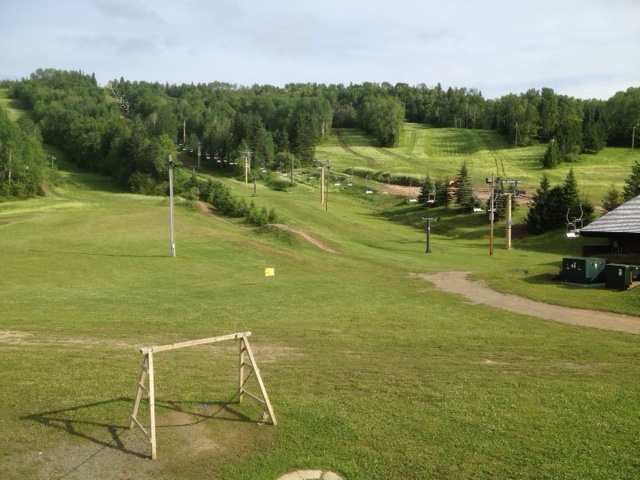
The so-called ski runs at Sugarloaf Provincial Park near Campbellton, N.B.
• Just after crossing the border from Quebec to New Brunswick, we set up our tents in the Sugarloaf Provincial Park campground. It’s right beside their, ahem, ski hill. Hill is the operative word. It appears to be about half the size of Burnaby Mountain but they’ve still managed to carve out a few runs. It’s hard to imagine the vertical being close to being satisfying whatsoever to B.C. skiers.
Our seventh province and fifth time zone!
• Reaching our seventh province on the trip wasn’t the only milestone achieved that day. It also marked the fifth and final time zone of the trip. And just before reaching New Brunswick, I passed the 6,000-kilometre mark for the trip. With our plans to make a side trip into Prince Edward Island, Clive and I will not only have cycled through nine provinces but likely have biked more than 7,000 kilometres.
• With the exception of a small leg cramp for a few days in Saskatchewan that didn’t delay our plans, I haven’t suffered any cycling injuries. It’s been during the down times where I’ve pulled off a trio of stupid, silly, bumbling, stumbling, fumbling seniors moments that have caused a few scrapes, bruises and cases of embarrassment.
The first came from taking a tumble while trying to get up from an unbalanced picnic table in Wawa, Ont. In the fall I managed to stab myself in the ribs with my laptop computer. The spot is still a little tender.
The second came when I stubbed myself on an elevated decorative paving stone while taking a shortcut through the parking lot of our hotel in Ottawa. The sprawl across the asphalt left me with two strawberry scrapes on my right hand, another couple on my leg and a bruised ego.
My right hand suffered another indignity this week. (I went into this journey still dealing with the aftermath of receiving six stitches to repair a cut on my middle finger incurred in a small fall from my bike on March 24.) To add injury to injury I managed to jam the finger between the middle and pinkie fingers on the same hand in a door at the washroom facility at Camping du Causapscal.
I put some cold water on it but I knew I needed ice. So I took the drastic measure of buying a whole bag of ice cubes from the campground office. I looked quite ridiculous walking around with my hand stuck in this big bag of ice for about half an hour, but it was worth it. It’s still a tad tender, but it would have been a lot worse without the ice. It would have been even better if I wasn’t such a klutz,
• Clive took the lead in punctures with his third of the trip Thursday. It occurred just outside of Campbellton, N.B., on our way to Dalhousie. It goes along with the flat tire he found while his bike was parked in the garage of cousin Linda and her husband Gerald in Langham, Sask., and the concrete screw that punctured his tire and tube and went out the other side in Ottawa.
I’ve had two – along the Yellowhead Highway about 100 kilometres west of Edmonton and between Lachute and Joliette, Que. Brody had his only one on his first day while on the Coquihalla.
• Mario, my former caustic colleague at the Burnaby/New West NewsLeader who continues to be a frequent cycling companion, always talked about what he called “The Dark Mall” in New Westminster. Well we came across what has to be called “The Dead Mall” in Dalhousie. While Brody had his sauna, Clive wanted to find a book to read during downtimes. He found a used bookstore online in the Darlington Mall. When we arrived – after getting directions from a couple of incredulous residents – there was a grand total of three vehicles in a massive parking lot. Only two letters were lit on the Darlington neon sign at the mall’s entrance. But the bookstore was there along with a scooter shop and a guitar store. That was it.
There’s a reason, though, the mall’s death knell has been sounded. The property is to become apartments.
Clive did pick up a book for $1 passing on the stack of 50 cent novels.
• A passing observation: There are a ton of classic Catholic churches in Quebec and New Brunswick, but by the eye from the side of the highway the Jehovah’s Witnesses are making an impact because many of the towns we biked through in both provinces had Kingdom Halls in them.
Kilometre count
Day 66: Rimouski to Mont Joli 40 km; Total: 5,864
Day 67: Mont Joli to Causapscal (This town needs to buy a vowel from Pat Sajak to put between the p and s. Our recommendation is an a.) 92 km; Total: 5,956
Day 68: Causapscal to Sugarloaf Provincial (N.B.) Park: 82 km; Total: 6,038
Day 69: Sugarloaf to Heron Bleu Campground, Charo, N.B., 50 km (lots of traipsing around Dalhousie); Total: 6,088
I had originally intended my second blog post to be on the topic of saunas, but now’s not the time. My carefully laid plans to get a sauna Sunday on the way through the village of Trois-Pistoles were disappointed by a closed facility. The website will tell you one thing. The schedule posted at the door will tell you another. Consequently, if I wrote a blog post today about saunas it would be a bitter and disappointing read, which isn’t at all how I truly feel about saunas. I’ll save that one for another day, preferably soon after I’ve had a satisfying sauna somewhere in the Maritimes. By now, Quebec saunas are a write off, my only options thus far in the province having been closed, too expensive, or providing a service that’s not really what I’m looking for (if you’re curious, go ahead and do a google search of saunas in Quebec City).
So then, what I’ll share with you today is an insider’s prospective on the lifestyle commonly called dirtbagging. This type of living has been called by many names in many cultures throughout history. It’s more gypsy than hobo, and in the modern parlance the word is usually combined with some pursuit that is the motivation for choosing this lifestyle (e.g. dirtbag climber, dirtbag skier, or, in this case, dirtbag cycle tourist). Living as a dirtbag means extracting as much experience from as little money as possible. This lifestyle becomes an art form that develops over time, and the combination of personal experience and knowledge shared between dirtbags can produce some truly spectacular results.
For myself, I enjoy the freedom of living this opportunistic lifestyle, as well as the interesting situations it brings about. When I’m travelling with Dad and Uncle, I get to stay in the campsites that they pay for, which suits me fine. Travelling alone, however, I will only pay for camping in extreme circumstances. I find camp spots off side roads, in city parks, at highway rest stops, and anywhere else where I can be decently hidden and get a good night’s rest.
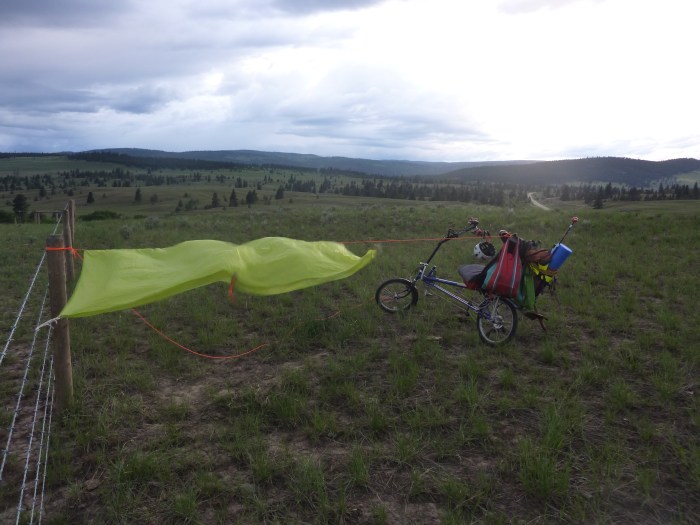
This brings me to a story which I promised my mother I would post to the blog. It was early on in the trip, just after splitting from Uncle in Merritt, B.C. I was travelling slowly due to my knee injury, riding only about 30 to 40 kilometres per day. I came to the turnoff for a small provincial park up a dirt road. The surrounding land was cattle pasture, usually fairly good for camping if you’re careful about where you step. After some searching around I found what I thought would be a good spot next to a barbed wire fence up on a hill overlooking the highway. The sun was low in the sky, the clouds were sparse, and the air was warm. I started to set up my shelter.
Brody’s bike parked alongside a fence on Highway 5A between Merritt and Kamloops way back in May.
During these first few days of the tour I was using a minimalist tarp shelter lent to me by my good friend Noriko. Uncle was borrowing the tent that I’m now travelling with, which is a free-standing shelter that doesn’t require much creativity to set up. By contrast, the minimalist tarp shelter needs to be strategically placed between two things to support it. These can be trees, fences, bicycles, or whatever else happens to be around. In this case I was planning to use a fence post at one end, and my bicycle at the other.
Then it got windy. Very windy.
The wind grabs ahold of Brody’s tarp and bike.
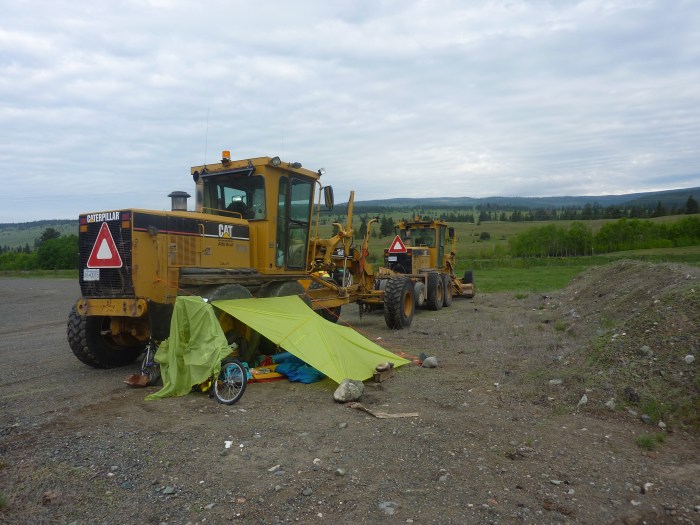
As well, looking up the valley in the direction the wind was coming from, it was plain to see that I had about half an hour before the onset of the coming rain. The shelter is a suitable length for Noriko, but is a foot or so too short for me, and in the driving wind and rain would have been slightly more than a decoration over me as I got soaked and cold. Some other solution needed to be found. I looked around. The big, yellow motor graders parked in the gravel pit beside the highway caught my eye.
I quickly packed the bike and headed down to the gravel pit, past the “NO ENTRY” sign that had now become very easy to ignore. The tower of iron and rubber that looked promising from a distance looked even better up close. It was a perfect wind block, and a structure to build a lean-to off of. Using the tarp shelter as a lean-to rather than a tent would allow me to set up diagonally in a way that would keep my feet dry. Ideal. I went about tying strings to the various parts of the heavy machinery, and by the time the first rain drops began to fall I had somewhere dry to hide.
I slept well through the night, until early in the morning when I was awoken by a rumbling noise of the sort made by a motor grader’s huge diesel engine. I knew there was no way an equipment operator could have missed a bright green tarp stretched out from the side of the machine, but just to be sure that my shelter wasn’t about to roll away I crawled out to greet him. As it turned out, it wasn’t the grader that I had used as shelter material that was running, but the one parked just in front of it.
“Good morning”, I started, “it was getting dark and there was some bad weather coming last night, so I pulled off the road and set up here.”
“That’s no problem, nobody will be using that grader today, so no rush. Nice shelter you’ve got there.”
Brody’s makeshift shelter from the wind.
“Thanks, yeah, it did the trick.”
And that was it. No animosity, probably no need for me to even provide an explanation as to why I’d made a fort out of heavy equipment. This highway worker had no inclination to drive me out of a spot which I really had no right to be in. It could be that he pitied me for my spartan accommodations, or that he himself was a dirtbag at some point in his past, or perhaps just that he really couldn’t care less that I was there, so long as I wasn’t in his way. Whatever the case, we had a friendly exchange before heading our separate ways. This is most often the case when dirt bagging, only very occasionally does a less lenient official greet you on the far side of the “NO ENTRY” sign, and it’s not something I’ve had to deal with on this trip.
Although economics will always be the main motivation for dirt bagging, these sorts of interesting experiences are a pleasant extra that comes with the territory. I encourage anyone who wishes to pursue their personal development to adopt the dirtbag lifestyle until the money runs out, and discover that the means are more rewarding than the end.
Thank you to all those who shared their thoughts about my last blog post. I noticed the majority of these were from mothers; the world would cease to function without encouraging mothers, so thank you.
The sun about to set on the St. Lawrence River just before the Canada Day fireworks at Montmagny, Que.
A short little update blog with pictures. For those looking for another entertaining edition of Brod on the Road, one should be forthcoming soon. The topic will be saunas. You’ll have to wait for it before finding out what that means.
We’re close to saying au revoir to Quebec – we’ve reached Rimouski which is up toward the Gaspe Peninsula and we’re about to turn southeast to New Brunswick – but before we do here are some pictures of our trip through La Belle Province.
Our trip from Trois Rivieres to the western outskirts of Quebec City (Saint-Augustin-de-Desmaures) came on a blustery day. There was one rainstorm and a bridge with a frightful see-through metal deck.
Brody surveys the Plains of Abraham.He also had a peak at what the British had to climb to reach the Plains of Abraham.
But on the final day of June the sun shone. First stop was the Plains of Abraham, which now are a federal park that is used for rugby, running and cycling.
Clive and Brody at the gates to Quebec’s Old City.
Although the weather was perfect for sightseeing in the Old City, the difficulty was, when you’re packing 50 to 60 pounds on a bicycle in a crowded and hilly area it’s hard to get around. It was a short visit of just a couple of hours, most of which was spent at an expensive bistro for lunch with the rest pushing our bikes up hills. But it was sure nice to sit out in the sunshine and watch the people admiring the ancient buildings. It’s a beautiful place, no doubt about it.
A long view of the bistro we had lunch at. The restoration and the upkeep of the old buildings, at least from the outside, is spectacular. The one that had the worst wear and tear, the Banque Nationale, was likely built in the 1960s or ’70s. Its sooty cement walls were unsightly compared to all the glorious old ones.
After that, we needed to get to the other side of the St. Lawrence to set up camp. Some had recommended taking the ferry across. In retrospect, we wish we had taken them up on their advice. We got ourselves into a freeway situation before realizing there was actually a pedestrian/cycling sidewalk on the other side of the Pont du Quebec. We managed to get a break in traffic long enough to scoot across to get on it.
The sidewalk, though, was scary too. It was narrow, the walls weren’t that high and you didn’t dare look down for fear of losing your balance. The drop down was extremely precipitous. Think the Ironworkers Memorial Bridge before it’s recent rehab only much higher and even narrower sidewalks. Not for the faint of heart, but the locals seemed to not mind using it because there were more cyclists on it than I’ve ever seen use any of the Greater Vancouver bridges.
Canada Day fireworks in Montmagny, Que.
On July 1, we headed for pretty city of Montmagny and its extremely busy municipal campground where we were treated to a 15-minute Canada Day fireworks display. It’s so far east in the time zone, and south for that matter, the show started at 9:30 p.m. when it was already dark. In B.C., it’s tough to start it at 10 p.m., because there’s still too much light only 10 days after the summer solstice.
Kilometre count
Day 61: Trois Riviére to Saint-Augustin-de-Demaures 122 km; Total: 5,467 km
Day 62: Saint-Augustin to Lévis 46 km; Total: 5,513 km
Day 63: Lévis to Montmagny 69 km; Total: 5,582 km
Day 64: Montmagny to Riviere du Loup 137 wind-aided km; Total: 5,719 km
Day 65: Riviere du Loup to Rimouski 105 km; Total: 5,824 km












 The 7 Cs blog